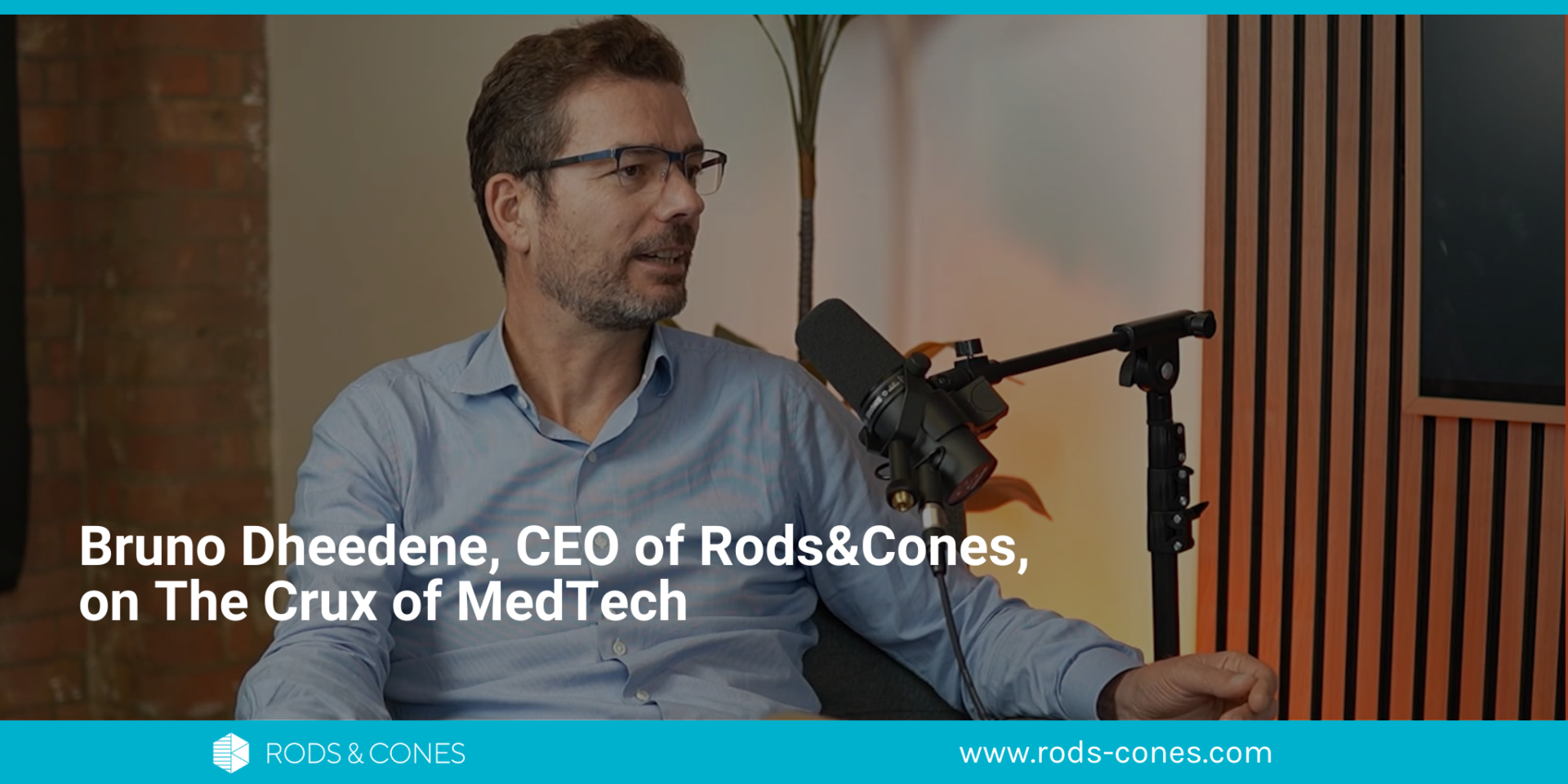
Bruno Dheedene, CEO and Co-Founder of Rods&Cones, recently joined The Crux of MedTech podcast for a 49-minute conversation about the founding story behind the company, the technology that powers it, and the mission driving it forward. Here’s a summary of the key themes from their discussion.
Scroll down to watch the full interview ↓
A hobby project that became a company — with a pandemic as its accelerator
The Rods&Cones story starts earlier than most people assume. Bruno began experimenting with the idea of remote surgical presence as far back as 2013, when he got his hands on Google Glass. The technology wasn’t ready — the camera quality wasn’t good enough for surgery and the streaming capacity fell short — but the problem he wanted to solve was already clear.
Having spent years as a rep himself, Bruno had seen firsthand the limitations of in-person medical education and case support in the operating theater. That experience — long before the idea took shape — planted the seed: could this be done remotely?
By 2018, the idea had become a project. A Flemish government feasibility study followed, and by the end of 2019 Rods&Cones was running its first real cases with selected customers. Then the pandemic hit.
“The pandemic was an enormous accelerator of our business. We onboarded a lot of customers out of the gate — so basically that was our first funding round.” The company has remained bootstrapped ever since, funded by founders and the board alone. “We are extremely capital efficient,” Bruno says. “It keeps a lot of autonomy, keeps a lot of decisions in our own hands.”
The problem: even people in the room can’t see what the surgeon sees
One of the most striking moments in the interview is Bruno’s explanation of the core problem Rods&Cones solves — because it’s less obvious than it sounds.
Even when a rep is physically in the operating room, they often can’t see anything useful. Surgery happens in small cavities, from the surgeon’s own point of view. Anyone not standing directly at the table is at least a metre away.
“If you’re not coming from the eyes of the surgeon, you don’t really see what he’s doing — even his assistant, or people around him. They don’t really see what he’s doing.”
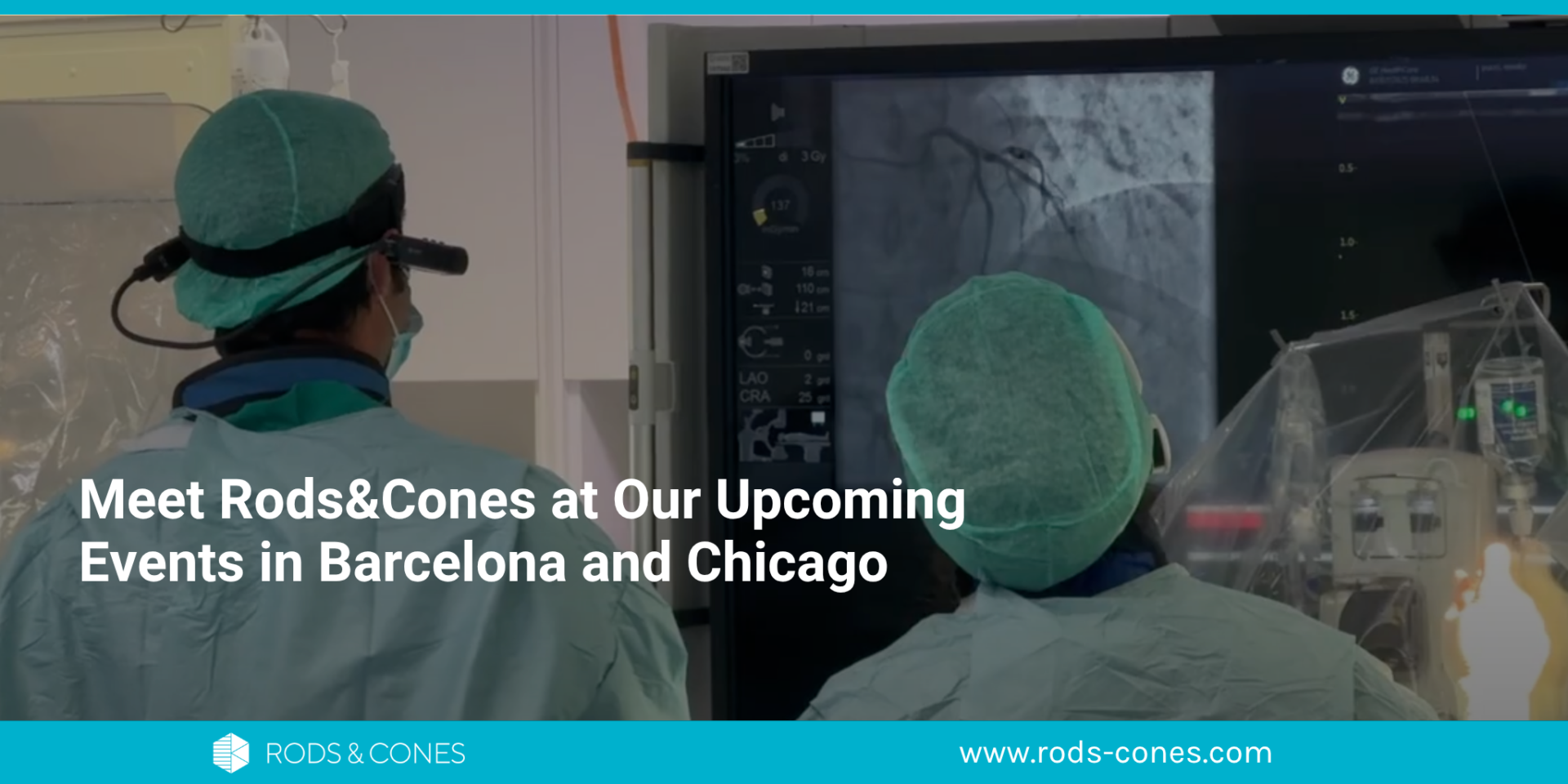
Rods&Cones’ solution starts with smart glasses: a 4K camera that sits in front of the surgeon’s eyes and streams exactly what they see to a remote expert. The remote person controls the zoom, light sensitivity, white balance and depth of field — the surgeon just has to wear the glasses.
From there, the platform expanded. A “mirror solution” captures video output from any device in the operating room and pipes it into the same remote view. And panoramic cameras, mounted on remotely controlled robots, give an overview of the whole room.
The robot, incidentally, has one of the best origin stories in the industry. “That little robot we use — it was actually made for horse influencers and horse trainers. They had an app and an API so it would track a horse. With that company we were able to integrate the SDK, and so we didn’t have to build hardware ourselves. We just look on the market to find hardware that suits our use case and then we integrate it into our system.”
More than a rep replacement — a MedTech helpdesk
Rods&Cones supports customers all along the product lifecycle: clinical phases, KOL-led education, new customer onboarding, and ongoing implant guidance. But Bruno is emphatic about what the platform is not.
It’s not a rep-reduction tool. It’s a growth-fuelling tool. You can have much more customer intimacy through Rods&Cones because you can have many more touchpoints with that customer.”
His vision is that MedTech companies use the platform to build always-on surgical support helpdesks. A surgeon can call at any time for any problem — and if the case is difficult, there are escalation levels: the company’s R&D team, or key opinion leaders in the US who can virtually scrub in.
Bruno describes cases of surgeries that happen just once a year in the Netherlands, where companies arranged for world-renowned KOLs to join virtually.
“You have my organisation in a box. Just call us.”
Geography matters here too. In central London, Bruno notes, you can have a rep on-site within hours. But in the north of Norway, people might need to fly in. In northern California, there are reps who have to drive four hours to reach a hospital. “Service levels are much more difficult to maintain in remote areas.”
Why 1mm matters: the case for intraoperative support
To illustrate the stakes of real-time support during surgery, Bruno points to hip replacement. If a new implant delivers a leg that is one millimetre off, the patient may feel it.
“Surgery was perfect, but it’s just this little offset that the patient feels — it’s not just what it was before.”
This kind of intraoperative guidance — on implant sizing, placement, angle — is something industry reps currently provide by standing three metres away with a pointer. With Rods&Cones, that same advice can be given remotely, by the right person, at the right moment.
On AI: an important trend, but still far off in surgery
The host asked Bruno whether AI might eventually disrupt what Rods&Cones does — particularly for use cases like stroke diagnosis. His answer was measured, backed by data from research partnerships with universities in the Netherlands.
Anatomical recognition in the upper thorax currently sits at a 78–83% accuracy interval. For nerves, it’s only 40%. Bruno’s argument is that for AI to be trusted in surgery, it would need to reach the kind of reliability expected in air traffic control.
“If it’s an 80% interval, one out of five would be wrong. You can’t really rely on it.”
He also points to a practical challenge: labelling surgical data requires trained surgeons, not crowdsourced annotation. Labelling 100,000 frames takes an enormous number of specialist hours.
Rods&Cones is actively involved in this research, and Bruno is not dismissing the direction of travel. “I don’t know if this will be in five years or in 15 years.” But for now, he notes, surgeons often identify structures not by sight but by touch — by grabbing, pulling, feeling.
That tactile knowledge has no visual equivalent yet.
Beyond the OR: stroke, triage, and 17 million untreated patients
The platform’s potential extends well beyond the operating room. Bruno describes work already underway on emergency triage — where a specialist can do a remote assessment instead of making a patient wait hours for someone to come in — and stroke management, where shortening “time to brain” after a stroke can be life-changing.
“Detecting a stroke with a patient is something done by the neurologist. We are seeing this can very much be done with our technology, being used by a paramedic, with the neurologist remotely doing the assessment. You have a very short time after a stroke — we can shorten that with our technology.”
But the aspiration that closes the conversation is bigger still. Rods&Cones has made a pledge to have 1 million people treated using their technology. And Bruno’s vision reaches further — to the 17 million people in Africa who go without surgery every year, not because surgery is impossible, but because local doctors don’t yet feel confident enough to act alone.
“A local surgeon somewhere in Africa — if they’re now a level 100, they can become a level 120 through Rods&Cones. Just by somebody who would assist them in a surgery that they know, they’ve seen once, they’ve done once, but they feel not confident enough to do by themselves.”
Discover how leading MedTech companies use our platform to deliver better surgical support, anywhere in the world.
Listen to the full episode
The full interview is available on YouTube.